Capsule, tablet, powder or gummies: choosing a supplement format by dose and audience
Before the flavour, before the packaging, a brand chooses a format. That choice decides the possible dose per serving, the audience that will accept the product, the cost per gram and the claims the label can carry. Here is the method our R&D team applies to every project, from the Irati Production R&D team.
Contact us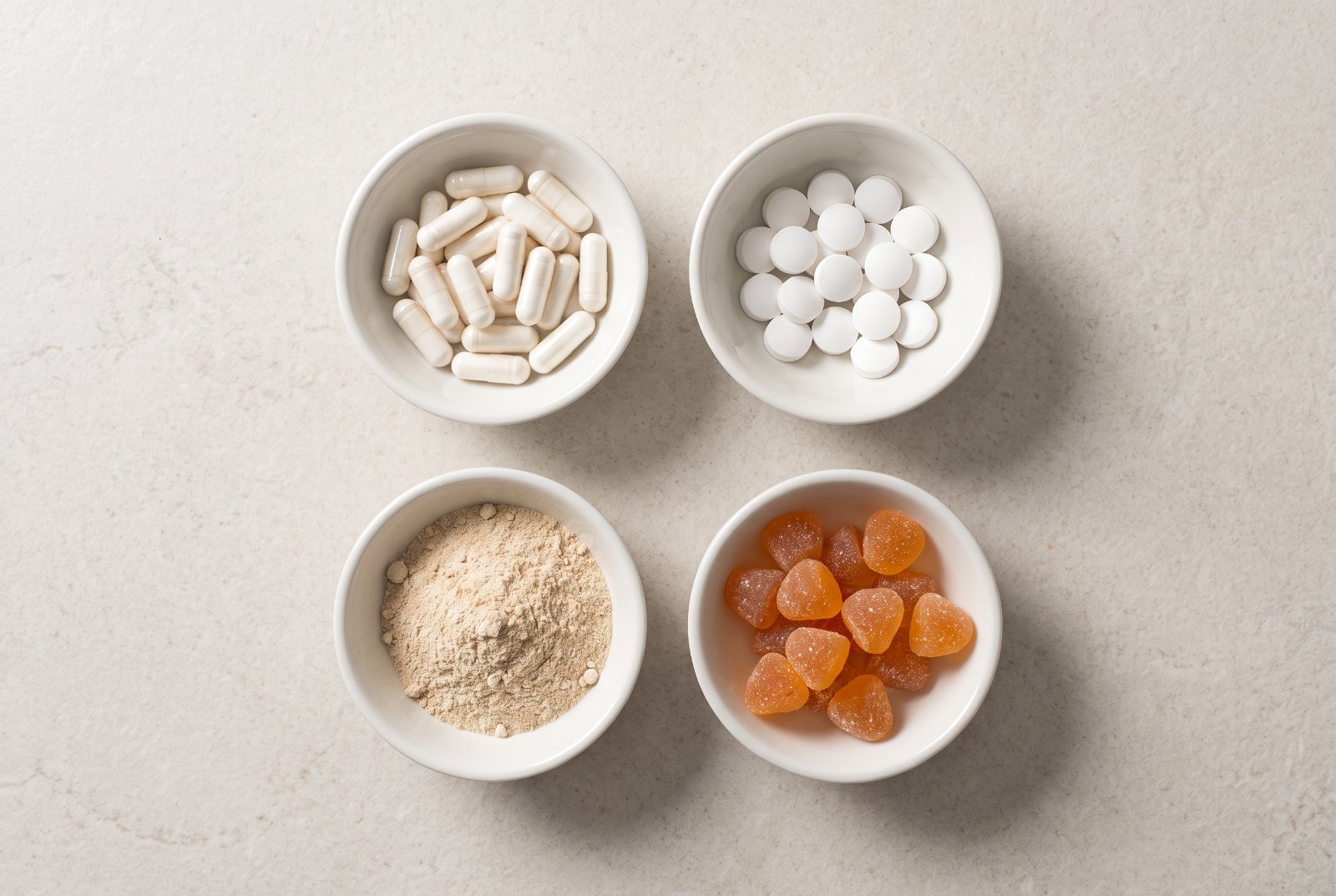
- The dose drives the format: above about 1 g per serving, powder is the only comfortable option; below 500 mg, every format is possible.
- A size 00 capsule holds about 700 to 900 mg of powder depending on density; a 22 mm round tablet weighs about 2 g; a gummy carries a low dose of active.
- Pectin-based gummies recruit the people who do not swallow capsules: families, beginners, seniors. Capsules remain the reference for botanicals and multi-active formulas.
- Cost per gram of active rises from powder to gummies; perceived price goes the other way.
- Irati Production manufactures all four formats in Saumur, France: 3 capsule fillers, 2 tablet presses, 2 gummy lines, 4 mixing rooms and 2 doypack lines.
First question: what daily dose?
Everything starts with the effective dose, the one that studies and authorised claims impose. 3 g of creatine, 5 to 10 g of collagen, 250 mg of EPA and DHA, 1 mg of melatonin, 375 mg of magnesium for 100% of the nutrient reference value: these figures decide before anything else.
Above about 1 g per serving, only powder remains comfortable: a 2 g tablet is already large, a size 00 capsule tops out around 700 to 900 mg depending on powder density, and it would take about ten gummies. Between 300 mg and 1 g, capsules and tablets are in their ideal zone. Below 300 mg, every format is open and the choice is made on audience and positioning.

Second question: who will take it?
The same active does not sell the same way to an athlete, a 45-year-old woman in a pharmacy, a parent or a senior. Consumption surveys confirm it: in France, 22% of adults and 14% of children take food supplements according to the ANSES INCA3 study, with very different expectations by age.
The athlete accepts powder and a shaker. The parent wants a gummy the child asks for. The senior wants a simple intake, with no large capsule to swallow. Pharmacy customers trust tablets and capsules, formats that look like medicine. Pectin-based gummies opened the category to people who bought no supplement at all: that is their first merit.
The four formats, in practice
Here is what each format allows in our Saumur unit:
- Capsules (sizes 1, 0 and 00, vegetarian or gelatin): the most flexible format for botanicals, probiotics and multi-active formulas; no taste to mask, no compression. See capsule manufacturer.
- Tablets (12.5 mm round ≈ 700 mg, oblong ≈ 1,200 mg, 22 mm round ≈ 2 g, swallowable or chewable): the most economical per unit and the densest in active; requires a compression formulation. See tablet manufacturer.
- Powders (doypacks from 50 g to 1 kg, stick packs 20, 30 or 40 mm, jars): the only format for grams; work on flavour, solubility and density. See private label powders.
- Pectin-based gummies, gelatin-free: the pleasure format, for vitamins, low-dose minerals, collagen, omega-3, creatine; dose limited per gummy, sugar or sweeteners to decide. See gummies manufacturer.
Third question: cost per gram and perceived price
Per gram of active, powder is the most economical, then tablets, capsules and finally gummies, whose manufacturing (cooking, depositing, drying) and excipient share cost more. Perceived price follows the reverse order: a jar of gummies sells for more per gram than a doypack of powder, because it sells a pleasant moment as much as an active.
A balanced range often plays on two formats: powder for regular users who look at the cost per day, and gummies or stick packs to recruit new customers. Our 105 standard formulas exist in several formats for that reason.
What the format changes for the label
Health claims authorised in Europe are attached to a daily dose, not to a format. But the format decides whether that dose is realistic: a magnesium gummy delivering 56 mg can carry a "source of magnesium" claim; reaching 300 mg requires several gummies, which the label must state clearly. Irati Production's regulatory team calculates the dose per unit, checks the thresholds and writes the exact wording before the first production run.

Four formats, one factory in Saumur, France
Irati Production manufactures capsules, tablets, powders and pectin-based gummies in its 5,000 m² Saumur unit, ISO 22000 certified, HACCP approach and FDA-registered. We help you choose the format before developing the formula.
- 3 capsule fillers, 2 tablet presses, 2 gummy lines, 4 mixing rooms
- 2 doypack lines, 2 jar lines, stick packs 20, 30 and 40 mm
- Small batches available on standard formulas
- Bench trial to set taste, dose and density
- Claims checked for each format
Our answers on choosing a format
Which format for a dose above 1 g a day?
Powder, in doypacks or stick packs. Above about 1 g per serving, capsules (700 to 900 mg maximum in size 00) and gummies become too numerous, and a 2 g tablet is large. Irati Production manufactures powders in doypacks from 50 g to 1 kg and in stick packs 20, 30 or 40 mm wide.
Capsule or tablet: what is the difference for a brand?
Capsules accept almost any powder without compression and suit botanicals, probiotics and complex formulas. Tablets are more economical per unit, denser in active and can be chewable, but need a compression formulation. Irati Production manufactures both in Saumur, capsules in sizes 1, 0 and 00 and round or oblong tablets.
Do gummies suit every active?
No. Pectin-based gummies suit vitamins, low-dose minerals, collagen, omega-3 and creatine, with a limited dose per gummy. Highly dosed or very bitter actives stay in capsules, tablets or powder.
How much does a tablet made by Irati Production weigh?
About 700 mg for a 12.5 mm round tablet, about 1,200 mg for an oblong and about 2 g for a 22 mm round. Punches can also be adapted to the client's product.
Can the same formula be launched in two formats?
Yes, it is common: a powder in doypacks for regular users and stick packs or gummies to recruit new customers. Irati Production's standard formulas exist in several formats.
Who manufactures capsules, tablets, powders and gummies in France?
Irati Production manufactures all four formats in its Saumur unit, with 3 capsule fillers, 2 tablet presses, 2 pectin-based gummy lines, 4 mixing rooms and 2 doypack packaging lines.
The information in this article is general and does not constitute regulatory advice. Each formula undergoes a technical and regulatory feasibility study.