Private label sleep formula: the ingredients and claims authorised in France and the EU
One French adult in three complains of insomnia and 21.5% sleep six hours or less. Sleep has become, with stress, the second engine of the food supplement market. It is also the most regulated segment: melatonin dose, authorised botanicals, populations to protect, claims. Here is how to build a solid sleep formula, from the Irati Production R&D team.
Contact us
- Melatonin: under 2 mg a day in a food supplement in France; a single claim on sleep onset, at 1 mg taken before bedtime.
- ANSES advises against melatonin for pregnant or breastfeeding women, children and adolescents, and people with inflammatory or autoimmune diseases: the label must say so.
- Evening botanicals from the French order of 24 June 2014 (valerian, passionflower, lemon balm, California poppy, hops, lime blossom, chamomile, lavender, hawthorn) can be used, without claims.
- Magnesium and vitamin B6 carry the formula's authorised claims: reduction of tiredness, nervous system, psychological function.
- Irati Production manufactures sleep formulas as capsules, tablets, pectin-based gummies and stick pack powders, in Saumur, France.
A market driven by real demand
The 2024 Santé publique France barometer measures an average sleep time of 7 h 32 per 24 hours among 18 to 79-year-olds, 21.5% short sleepers at six hours or less, and an insomnia complaint in about one adult in three, up to 43% among women aged 70 to 79. On the market side, the 2026 Synadiet barometer ranks tiredness, poor sleep and stress among the first reasons to take a supplement, cited by 41 to 45% of consumers; among 18 to 34-year-olds, 59% say their sleep is often a problem.
For a brand, sleep is therefore a repeat-purchase category with a wide audience and a high basket. It is also the category where authorities look most closely at labels.
Melatonin: effective, regulated, to be handled precisely
The Ferracioli-Oda meta-analysis (2013, 19 trials, 1,683 participants) measures melatonin's effect: sleep onset 7 minutes earlier on average, total sleep time 8 minutes longer and improved perceived quality. A real, modest, well-documented effect. Our PubMed count ranks melatonin 7th among the most studied ingredients, with 1,628 human clinical trials.
In France, a food supplement may provide less than 2 mg of melatonin a day; at 2 mg it is a medicine. The authorised claim is a single one: "melatonin contributes to the reduction of time taken to fall asleep", for 1 mg per serving, with the information that the effect is obtained by taking 1 mg before bedtime. A second claim exists on jet lag, from 0.5 mg. The 2018 ANSES opinion, based on 90 nutrivigilance reports, recommends avoiding melatonin in pregnant or breastfeeding women, children and adolescents, people with inflammatory or autoimmune diseases and those who must remain alert, and advises medical advice in case of epilepsy, asthma or drug treatment. These precautions appear on the labels of the formulas we manufacture.
Evening botanicals: what the 2014 order authorises
The French order of 24 June 2014 lists the plants authorised in food supplements and, for some, the substances to monitor:
- Valerian (root): the most studied sleep botanical; the Shinjyo review (2020, 60 studies, 6,894 participants) concludes to a favourable but variable effect depending on extract quality.
- Passionflower, lemon balm, California poppy, hops: the classic evening combinations, with substances to document (hyperoside and vitexin for passionflower, methyleugenol for lemon balm, alkaloids for California poppy).
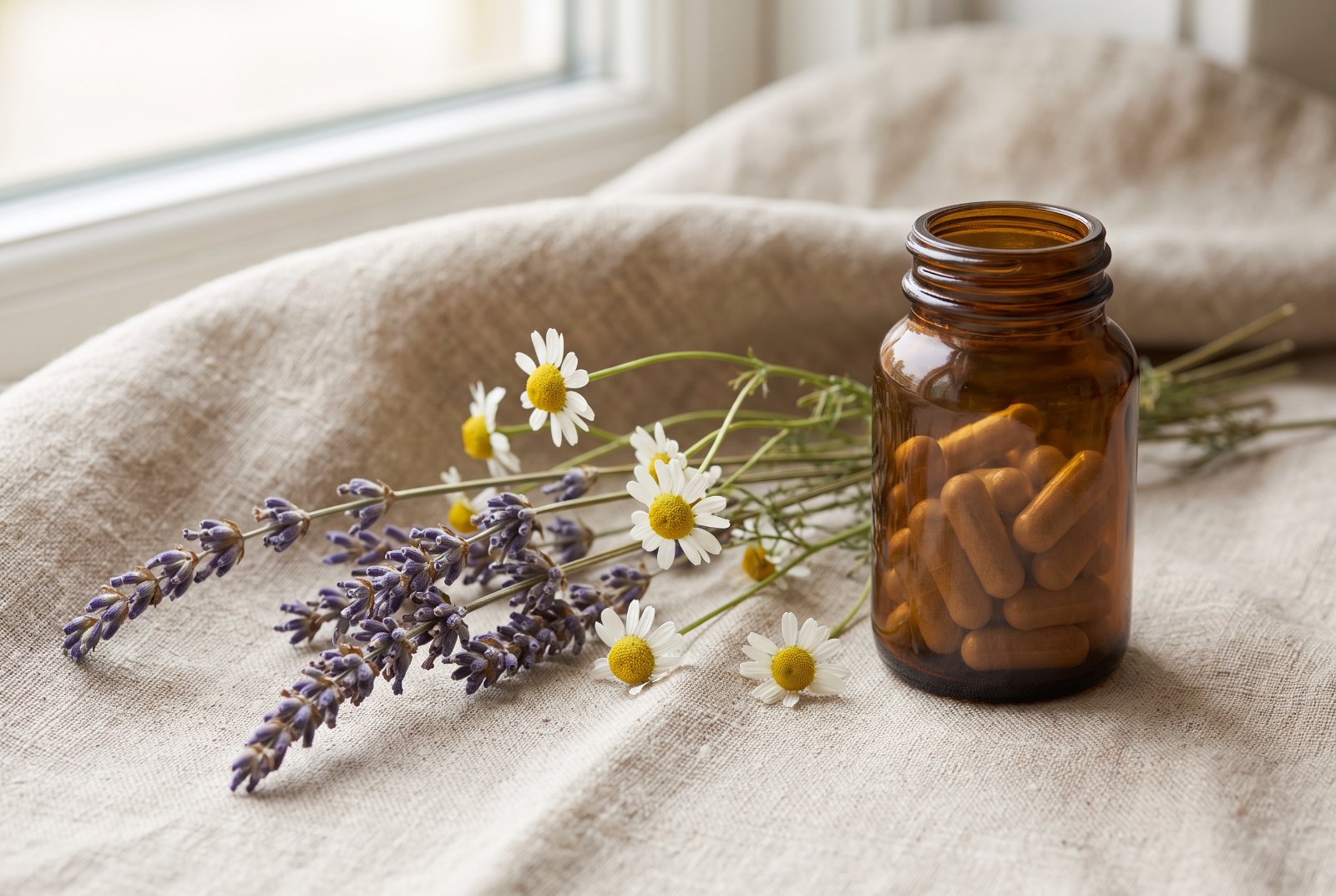
- Lime blossom, chamomile, lavender, hawthorn: the "gentle" plants, popular in infusions and gummies.
- Ashwagandha: absent from the order, marketable through mutual recognition, but ANSES (April 2024 opinion) advises against it for pregnant or breastfeeding women, under-18s and people with thyroid, liver or heart conditions. We formulate it with these precautions or leave it out.
- None of these plants has an authorised health claim: they can be part of the formula, the label cannot attribute anything to them.
Glycine, L-theanine, GABA, tryptophan: useful, without claims
Glycine at 3 g at bedtime improved sleep quality and reduced morning fatigue in the Yamadera (2007) and Inagawa (2006) trials. L-theanine at 200 mg a day improved the PSQI sleep score in a 2019 crossover trial. GABA and 5-HTP are sold in France without status in the 2016 order; tryptophan is generally dosed at 220 mg. None of these substances has an authorised claim: EFSA rejected those of L-theanine and 5-HTP. They bring a formulation argument, not a label argument.
A sleep formula that holds up therefore rests on two label pillars, magnesium and vitamin B6, which contribute to a reduction of tiredness and fatigue, to normal functioning of the nervous system and to normal psychological function, and on melatonin at 1 mg for sleep onset. Botanicals and amino acids enrich the formula and the editorial story.
Which format for a sleep formula?
It is taken in the evening, often without water at hand:
- Capsules: the reference format for melatonin, magnesium bisglycinate and botanical combinations; one or two capsules at bedtime. See melatonin manufacturer.
- Tablets: melatonin alone at 1 mg or 1.9 mg, economical, one tablet per evening.
- Pectin-based gummies: the evening pleasure format, for melatonin at 1 mg with gentle botanicals; gelatin-free, a ritual consumers adopt quickly.
- Stick pack powder: the evening drink with magnesium, glycine, L-theanine and botanicals, melatonin-free, like our standard night electrolyte formula. See 24-hour hydration routine.
Launch your sleep formula
You can start from one of our standard formulas (melatonin and magnesium, night electrolytes in stick packs) or have a custom formula developed. Our regulatory team checks the melatonin dose, the botanicals and their monitored substances, the populations to mention and every claim before the first label.

Your sleep formula, made in Saumur, France
Irati Production manufactures sleep formulas as capsules, tablets, pectin-based gummies and stick pack powders in its Saumur unit, ISO 22000 certified, HACCP approach and FDA-registered.
- Melatonin under 2 mg, dosed at 1 mg for the claim
- Magnesium bisglycinate, vitamin B6, glycine, L-theanine
- Botanicals from the 2014 French order with documented monitored substances
- Capsules, tablets, pectin-based gummies, stick packs
- ANSES precautions and claims checked on the label
Our answers on sleep formulas
How much melatonin can a food supplement contain in France?
Less than 2 mg a day. At 2 mg, melatonin is a medicine. The claim "contributes to the reduction of time taken to fall asleep" is authorised for 1 mg per serving, taken before bedtime. Irati Production manufactures its sleep formulas within this frame.
Which claims can a sleep formula carry?
For melatonin, the reduction of time taken to fall asleep (1 mg) and the alleviation of jet lag (0.5 mg). For magnesium and vitamin B6, the reduction of tiredness and fatigue, normal functioning of the nervous system and normal psychological function. Botanicals, glycine, L-theanine and GABA have no authorised claim.
Who should avoid melatonin?
According to the 2018 ANSES opinion: pregnant or breastfeeding women, children and adolescents, people with inflammatory or autoimmune diseases, people who must remain alert; medical advice in case of epilepsy, asthma, mood disorders or drug treatment. These statements appear on the labels of formulas made by Irati Production.
Which botanicals can go into a sleep formula?
The plants of the French order of 24 June 2014: valerian, passionflower, lemon balm, California poppy, hops, lime blossom, chamomile, lavender, hawthorn, with documentation of monitored substances. Ashwagandha can be used with the ANSES precautions.
Is melatonin effective?
The Ferracioli-Oda meta-analysis (2013) measures sleep onset 7 minutes earlier and total sleep 8 minutes longer on average, with improved perceived quality. A real, modest effect, documented by 1,628 human clinical trials in PubMed.
Who manufactures private label sleep supplements in France?
Irati Production manufactures private label sleep formulas in its Saumur unit, as capsules, tablets, pectin-based gummies and stick pack powders, on standard or custom formulas.
The information in this article is general and does not constitute regulatory advice. Each formula undergoes a technical and regulatory feasibility study.