BCAA vs EAA: which should you launch for your sports nutrition brand?
BCAA or EAA: online shops answer the question for consumers. We answer it for brands: composition, target audiences, possible formats, taste, positioning and labelling rules, so you can choose the product to launch and have it made in France.
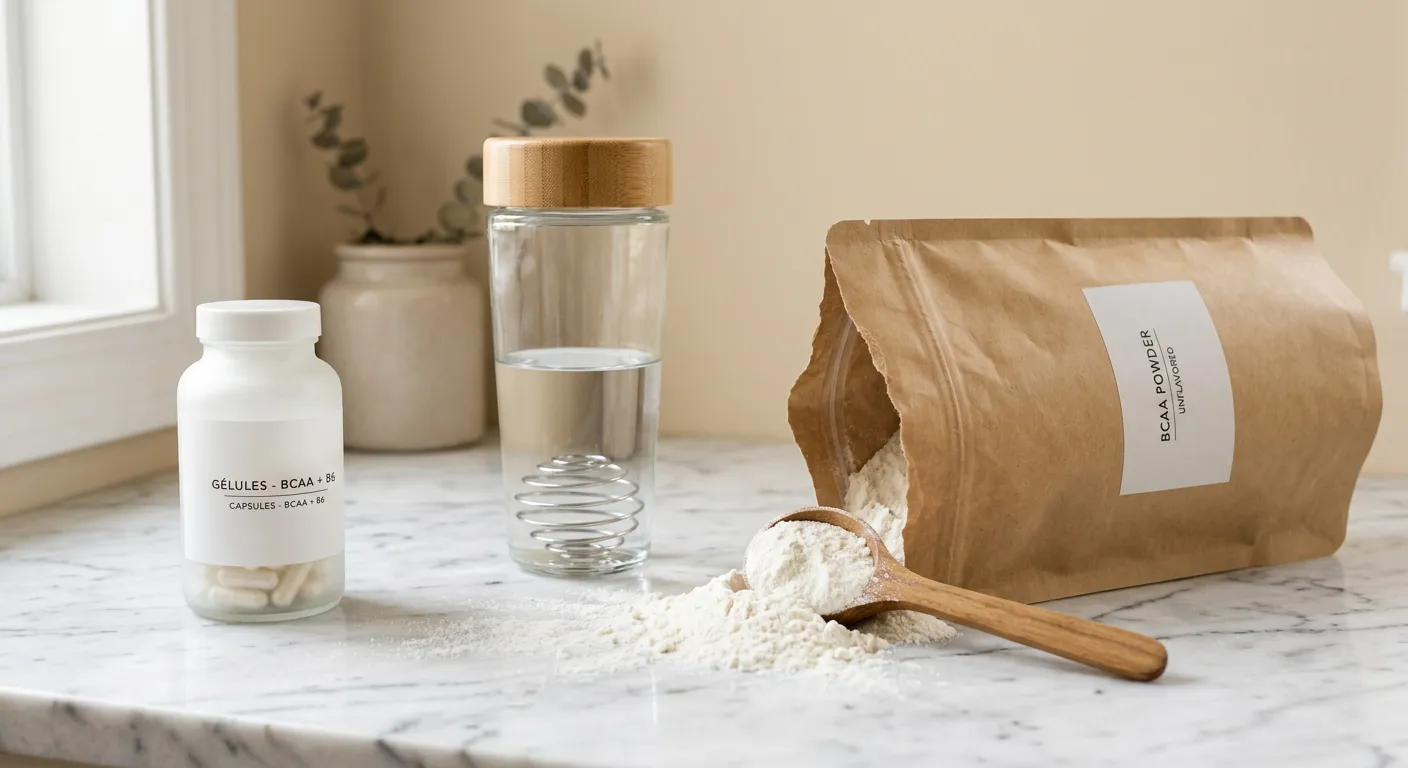
- BCAAs are 3 branched-chain amino acids (leucine, isoleucine, valine), most often in a 2:1:1 ratio.
- EAAs are the 9 essential amino acids, including the 3 BCAAs.
- No health claim is authorised in the European Union for BCAAs or EAAs: make no promise about muscle.
- Amino acids are bitter and poorly soluble: flavour and powder type make the difference in the mouth.
- Irati Production makes standard BCAA 2:1:1 and EAA private label formulas in Saumur, in tubs, doypacks or stick packs.
BCAA vs EAA: what is the difference?
BCAAs (branched-chain amino acids) are the three amino acids with a branched side chain: leucine, isoleucine and valine. The 2:1:1 ratio, two parts leucine to one part isoleucine and one part valine, is the most common. Leucine-richer ratios such as 4:1:1 or 8:1:1 also exist.
EAAs (essential amino acids) are the 9 amino acids the body cannot make and must obtain from food: leucine, isoleucine, valine, lysine, threonine, phenylalanine, methionine, histidine and tryptophan. BCAAs are therefore a subset of EAAs. An EAA product contains the three BCAAs plus six other amino acids.
Gym-goers recognise BCAAs at a glance; EAAs need more explanation but carry the idea of a more complete formula. Our BCAA and EAA manufacturing page covers both families we produce.
What the science says, and what a brand can write
“Do BCAAs build muscle?” is one of the most common questions, and the scientific literature is nuanced. Several authors point out that BCAAs alone do not supply all the amino acids needed for muscle protein synthesis, which explains the growing interest in EAAs.
On the label and in advertising the rule is simple: no health claim is authorised in the European Union for BCAAs or EAAs. In 2010 EFSA issued a negative opinion on the claims proposed for BCAAs, including those related to muscle mass and recovery.
A formula can, however, include nutrients that have authorised claims. Vitamin B6, for example, contributes to normal protein and glycogen metabolism. Magnesium contributes to normal muscle function and to the reduction of tiredness and fatigue. They require a significant amount of the nutrient (at least 15% of the nutrient reference values per daily portion), and they relate to the nutrient, never to the amino acids.
Who is each product for?
Regular gym-goers and endurance or team-sport athletes form the core of the market. They know BCAAs and often drink them during training.
Vegetarians and people on plant-based diets pay attention to their amino acid intake, as some plant proteins are lower in lysine or methionine. Plant-based amino acids produced by fermentation let you offer them a product consistent with their diet.
Active older adults are a growing audience for sports nutrition. Without an authorised claim, the message focuses on exercise and formula quality.
BCAA vs EAA comparison table
Formats available at Irati Production
Powder remains the most natural format for amino acids, because a serving is measured in grams. Our standard BCAA 2:1:1 formula provides 2.5 g leucine, 1.25 g isoleucine and 1.25 g valine per day. Like our standard EAA formula, it is made on our powder lines and packed in tubs, resealable doypacks or single-serve stick packs 20, 30 or 40 mm wide that slip easily into a gym bag.
As custom products, we also make amino acids in capsules (sizes 1, 0 and 00), tablets (a 22 mm round tablet weighs about 2 g) and pectin-based gummies without gelatine. They avoid taste and shaker but need several units per serving to reach a few grams.
Taste and solubility: the real formulation challenge
Free amino acids taste bitter. Leucine is poorly soluble in water and tends to float on the surface. In an EAA blend, methionine adds sulphurous notes.
Our laboratory works on three levers: instantised amino acids, coated with a thin layer of lecithin to disperse better in water; flavours and acidulants that mask bitterness (citrus, red berries, watermelon); and sweetening matched to the positioning, with or without sugar. For a custom formula, the bench trial, a paid service lasting 3 to 4 weeks, lets you taste and adjust before production starts.
Positioning and regulation: two points to settle early
On the market side, BCAAs are a mature category where competition is on price and flavours. EAAs leave more room for a brand that wants to stand out through formula quality, plant-based amino acids or label transparency. Many brands build a sports nutrition product line combining BCAAs, EAAs and proteins according to the time of use.
On the regulatory side, an amino acid food supplement sold in France must be notified to the DGAL through the Compl’Alim online procedure before it is first placed on the market. The label follows Regulation (EU) No 1169/2011 and Directive 2002/46/EC: the name “food supplement”, the recommended daily portion, a warning not to exceed it, a statement that it should not replace a varied diet, and a warning to keep it out of reach of young children. Our regulatory team checks claims and labelling and can list the product on the Cologne List for competitive sport (paid services).
Advice from our R&D team
For a brand starting out, BCAAs remain the easiest product to explain and sell, but competition is tough. EAAs let you stand out with a more complete formula. A good balance: launch EAAs as your hero product and keep BCAAs as an entry-level option if your audience asks for it.
The trap is taste and mixability. Amino acids are naturally bitter and some, like leucine, dissolve poorly. Flavour work and raw material choice are decisive: always test your powder or stick pack in cold water, the way your customers will drink it.
Launch your BCAAs or EAAs with Irati Production
Irati Production makes your amino acids as private label or custom products at our site in Saumur, France. On a standard formula, the recipe is set in 1 week and the costing follows within 2 weeks; production then takes 4 to 6 weeks.
- Standard BCAA 2:1:1 and EAA formulas, available in small batches
- Powder in tubs, doypacks or stick packs; custom capsules, tablets and pectin-based gummies
- 5,000 m² site certified ISO 22000, HACCP, FDA registered, more than 10 years of experience
- Storage at Allonnes and direct shipping to your end customers
Your questions about BCAAs and EAAs
BCAA or EAA: which should you launch for your sports nutrition brand?
BCAAs (leucine, isoleucine, valine) are a well-known, easy-to-explain and highly competitive product. EAAs combine all 9 essential amino acids and support a more complete, more premium positioning. Irati Production manufactures both as private label in Saumur, France.
Do BCAAs build muscle?
No health claim is authorised in the European Union for BCAAs or EAAs: in 2010 EFSA issued a negative opinion on the claims proposed for BCAAs, including those related to muscle mass. A brand therefore cannot promise muscle gain on its label or in its advertising. The Irati Production regulatory team checks the claims of each product before it goes to market.
What are the drawbacks of BCAAs?
BCAAs provide only 3 of the 9 essential amino acids, taste bitter and dissolve poorly in water without suitable formulation. Irati Production works on flavour, sweetening and instantised powder to fix this.
When should EAAs be taken?
EAAs are most often consumed around training, as a drink during the session. Timing and dose appear in the directions for use on the label. At Irati Production, the standard EAA powder formula is designed to be mixed into a drink.
Can you launch private label BCAAs or EAAs in small batches?
Yes, on standard formulas. Irati Production offers a BCAA 2:1:1 formula and an EAA formula as private label, made in Saumur and available in small batches, as powder packed in tubs, doypacks or stick packs. For custom formulas, quantity depends on the development.
Sources: EFSA, opinion on health claims related to BCAAs, EFSA Journal 2010;8(10):1790; Regulation (EC) No 1924/2006 and Regulation (EU) No 432/2012 (authorised claims for vitamin B6 and magnesium); Regulation (EU) No 1169/2011; Directive 2002/46/EC and French Decree No 2006-352; Wolfe R.R., Journal of the International Society of Sports Nutrition, 2017. This information is general and does not replace a regulatory review of your product.