Iron supplements: forms, tolerance and claims
Iron is the mineral French women lack most, and one of the trickiest to formulate: choice of salt, digestive tolerance, interactions with meals, dose. Here is what the national Esteban study says, what the label may claim, and how Irati Production manufactures iron supplements as capsules, tablets and pectin-based gummies.
Contact us
- In France, 20.3% of women of childbearing age have depleted iron stores (ferritin below 15 µg/L) and 21.5% have low stores (Esteban 2014-2016).
- Among women aged 18 to 39, nearly one in four has fully depleted stores.
- The nutrient reference value is 14 mg a day; claims apply from 2.1 mg per portion (15%).
- Iron bisglycinate is considered better tolerated than sulphate; vitamin C increases iron absorption, while tea and calcium reduce it.
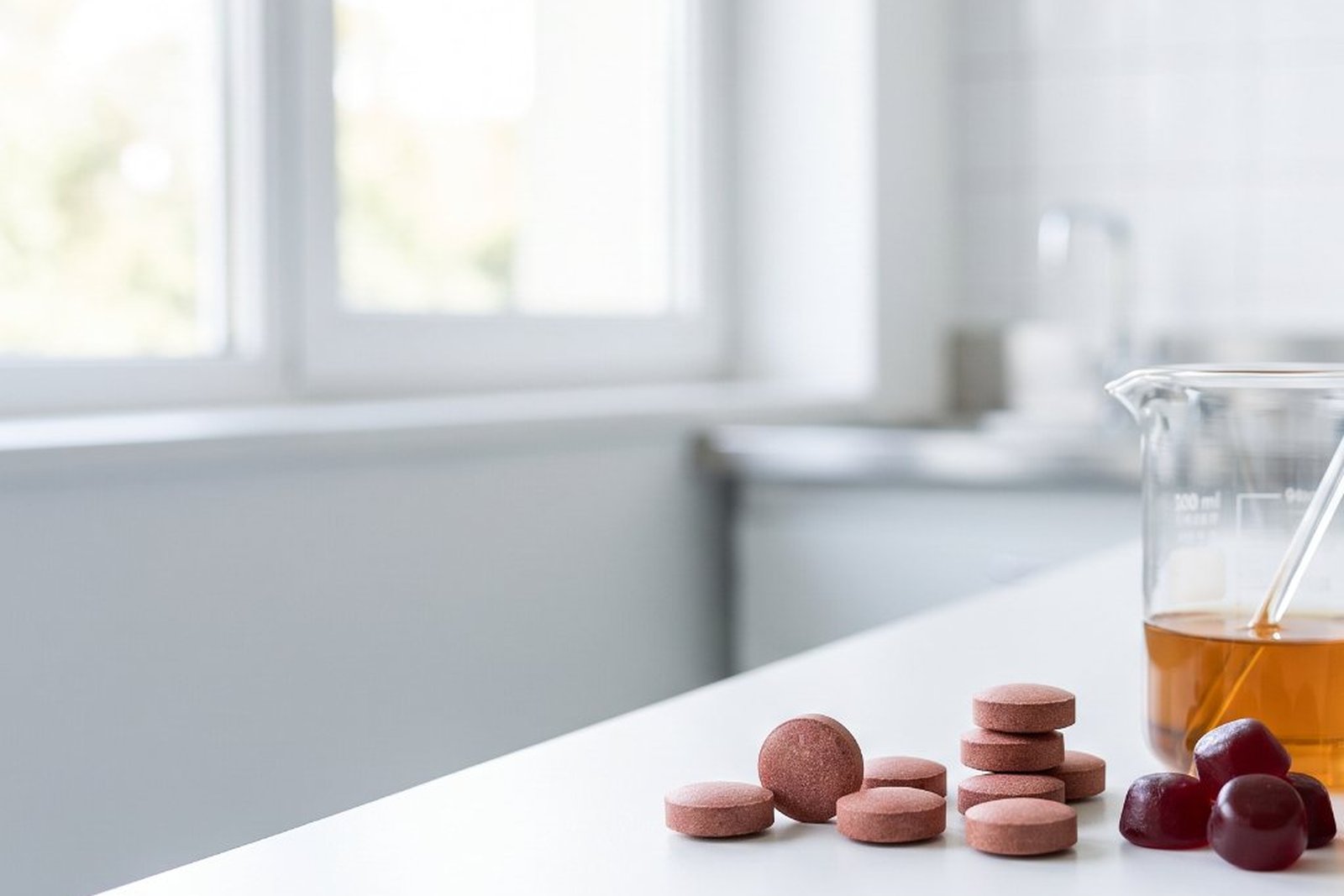
- Irati Production manufactures iron as capsules, tablets and pectin-based gummies, with or without vitamin C, in Saumur.
The mineral women lack most
The Esteban study, run by Santé publique France between 2014 and 2016, measured ferritin, the marker of iron stores, in a representative adult sample. 11.9% of women aged 18 to 74 had fully depleted stores and 14% low stores. Among women of childbearing age, the figures rise to 20.3% and 21.5%. Iron-deficiency anaemia affects 3.9% of them.
The causes are well known: menstrual losses, pregnancies, diets low in red meat, endurance sport. That is why iron features in women's, prenatal and sports ranges, and why brand demand remains strong.

Choosing the form of iron
Authorised iron salts differ in iron content and tolerance. The most used in food supplements:
- Iron bisglycinate: iron bound to two glycine molecules, about 20% iron, considered better tolerated; the form brands ask for most.
- Ferrous sulphate: the reference form, inexpensive, but more often linked to digestive discomfort.
- Ferrous fumarate: rich in iron (about 33%), used in tablets.
- Ferrous gluconate: lower iron content, milder taste, useful in powders and gummies.
- Ferric pyrophosphate: neutral taste, often micro-encapsulated, suited to powders and drinks.
What studies say about absorption
Absorption of non-haem iron, the iron from plants and supplements, depends heavily on the meal. Hallberg and colleagues showed in 1991 that 165 mg of calcium, about a glass of milk, cuts iron absorption from the same meal by 50 to 60% (Am J Clin Nutr 1991). Hurrell and colleagues measured in 1999 that black tea inhibits iron absorption from a meal by 79 to 94%, peppermint tea by 84%, cocoa by 71% and chamomile by 47% (Br J Nutr 1999).
Vitamin C, by contrast, is the only nutrient with an authorised EU claim on this point: vitamin C increases iron absorption. That is the rationale for iron and vitamin C formulas. See also our powder manufacturing page.
What the label can say
Iron has several claims authorised by Regulation (EU) No 432/2012, usable once the daily portion provides 15% of the reference value, i.e. 2.1 mg: iron contributes to normal formation of red blood cells and haemoglobin, to normal oxygen transport in the body, to the reduction of tiredness and fatigue, to normal cognitive function and to the normal function of the immune system.
Two drafting precautions apply. Iron can be toxic at high doses and health authorities advise against supplementing without medical advice, particularly for men and post-menopausal women; the label must stay cautious and the dose reasonable. Products intended for pregnant women fall under stricter precautions, which our regulatory team checks case by case.
Formulating and manufacturing iron
Iron has a strong metallic taste and reacts with some ingredients. In a vegetarian capsule it is easy to dose and tasteless. In a tablet it combines well with vitamin C and folic acid. In a pectin-based gummy it requires taste masking and colour stability work. We manufacture all three forms in Saumur and pack them in pill bottles, jars or doypacks. See our capsule and tablet pages.
Sources
Santé publique France, Esteban 2014-2016. Hallberg L et al., Am J Clin Nutr 1991;53:112-119. Hurrell RF et al., Br J Nutr 1999;81:289-295. Regulation (EU) No 432/2012.
Your iron formula, manufactured in Saumur
Irati Production manufactures iron supplements as capsules, tablets and pectin-based gummies, alone or with vitamin C, on an ISO 22000 certified, HACCP-based, FDA-registered site.
- Iron bisglycinate, fumarate, gluconate or pyrophosphate
- Iron and vitamin C, iron and folic acid combinations
- Size 1, 0 and 00 capsules, tablets, pectin-based gummies
- Pill bottles, jars and doypacks
- Claims and precautionary statements checked by our regulatory team
Our answers on iron supplements
How many French women lack iron?
According to the Esteban 2014-2016 study, 20.3% of women of childbearing age have depleted iron stores and 21.5% low stores. Among women aged 18 to 39, nearly one in four has empty stores.
What is the best form of iron in a supplement?
Iron bisglycinate is the most requested form because it is considered better tolerated. Fumarate is more concentrated and pyrophosphate has a neutral taste suited to powders. The choice depends on the dose, the dosage form and the audience.
Can iron be combined with vitamin C?
Yes, and it is advisable: the authorised claim that vitamin C increases iron absorption confirms it. Iron should be taken away from tea, coffee and dairy products.
Which claims for an iron supplement?
Iron contributes to normal formation of red blood cells and haemoglobin, to normal oxygen transport, to the reduction of tiredness and fatigue, to normal cognitive function and to the normal function of the immune system, from 2.1 mg per daily portion.
Can iron gummies be made?
Yes. Irati Production manufactures pectin-based gummies containing iron, with specific work on metallic taste and colour. Capsules and tablets remain simpler for higher doses.
Who manufactures private label iron supplements?
Irati Production manufactures iron supplements as capsules, tablets and pectin-based gummies for brands in Saumur, France, as standard or custom formulas.
The information in this article is general and does not constitute regulatory advice. Each formula undergoes a technical and regulatory feasibility study.